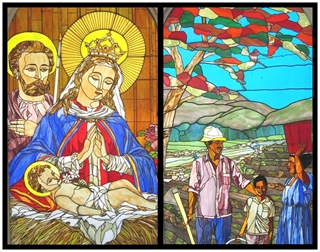
 Our relationship with Sabana Yegua (the central area of La Sagrada Familia parish) dates back to 1981, when then-Archbishop Rembert Weakland sent a letter to Bishop Ronald Connors, from the Diocese of San Juan de la Maguana in the Dominican Republic, indicating that the Archdiocese of Milwaukee would send two priests to minister there. In his letter, Archbishop Weakland stated, "We do indeed want to be of help and I know that this is one area of the world where there is truly a need and where we can assist." Thus, a relationship of ministry between the two dioceses was begun which has developed into a relationship of sharing faith and friendship, solidarity, and ongoing ministry.
Over the years, nearly twenty priests from Milwaukee have ministered in La Sagrada Familia: Richard Broach, Thomas Demse, Robert Stiefvater, Ronald Gramza, Vincent Kobida, Dennis Dirkx, James Schuerman, Kevin Murphy, Donald Hying, Kenneth Clapp, Robert Wells, Jerome Thompson*, Marti Colom, Oriol Regales, Juan Manuel Camacho, Esteban Redolad, Javier Guativa, and Thomas Naidu. A good number of lay missioners have also helped in the parish. Currently, the priests forming the pastoral team in our sister parish are Father Javier Guativa and Father Thomas Naidu, with the help of Pastoral Associate, Dolores Puértolas.
Every year, people from various Milwaukee parishes travel to La Sagrada Familia, thus strengthening the bonds of friendship and solidarity between our archdiocese and the people of the Dominican Republic. Currently, several parishes throughout the archdiocese have an ongoing La Sagrada Familia ministry, and more communities are looking into starting their own.
Much has been accomplished throughout the years of our growing friendship and support. For example, part of our current pastoral plan is our three nutrition centers, which provide basic nutrition and preschool education daily to 160 children, ages 1 through 6. There is also a health program, with a main clinic in Sabana Yegua and a network of pharmacies throughout the parish. Additionally, there is a program to build latrines, a sewing center where women learn basic skills, a parish bakery, a program to teach literacy to adults, and a growing ministry with Haitian immigrants. While some villages still lack a proper chapel, nowadays most of the communities have a church for the people to gather and celebrate their faith (four new small churches have been built in the last eight years).
We are grateful for a great history of harmony and shared dreams and are looking forward to many more years of partnership in mission with our brothers and sisters from the Dominican Republic.
*Father Jerome Thompson was pastor of Sagrada Familia from October 2001 until May 2003. In early May he returned to Southeastern Wisconsin to attend the annual Spring Priests' Assembly. On May 15, as he was in the Milwaukee airport security screening area he suddenly collapsed. He never regained consciousness and died of a cerebral aneurysm on May 17. Jerome was to have retired as pastor there on the feast of St Jerome at the end of October and soon after, begin as pastor of St. Patrick in Racine. God had other plans.